


At SWD we’ve noticed that the term ‘doormaxxing’ has recently emerged as part of a wider move towards treating everyday architectural details as opportunities for design; with internal doors becoming increasingly distinctive in a number of ways.
For bespoke joinery, it’s actually a principle that we’ve seen on the rise for a while. The height and width of a door, the way it relates to the interiors around it and the materials and hardware used to finish it have always influenced how successfully it sits within a home. What has changed though, is the amount of attention that these details are now receiving. Where a door sits and how much of that room it actually occupies, has become one of the most notable signs of a considered interior; leaving a lasting impression long after leaving a room.

Building Doors for Grand Proportions
As contemporary homes have introduced higher ceilings and larger openings, standard door proportions aren't always the most natural fit. Taking a doorset higher can create a much stronger visual impact, particularly in rooms where conventional dimensions would leave a large expanse of wall above the frame. The beauty of a bespoke door for these properties is that nothing about the design needs to be scaled down to fit a standard opening; the opening, in effect, is already a blank canvas for the door.

This doesn't necessarily mean that you must create an imposing door. In fact, some of the most successful examples of ‘doormaxxing’ that we’ve seen are relatively restrained. Extending clean panelling can often be more than enough to emphasise the proportions of a room without introducing anything ‘OTT’.
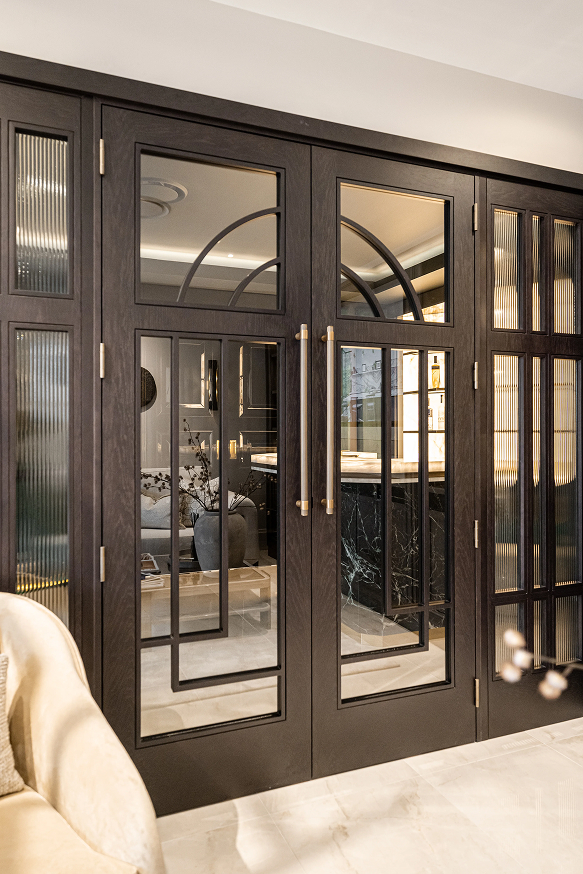
Where a full-height doorset isn't appropriate, glazed panels or arched glass above the door can also introduce additional height whilst simultaneously creating an opportunity to repeat detailing that can be found elsewhere in the interior.


Wider openings can offer similar possibilities, for example, the introduction of double doors can create a more generous transition between a master bedroom and bathroom, or between the hallway and entertaining spaces, where the opening itself creates a sense of grandeur.

Because SWD’s internal doors are made to measure, these proportions can be established around the architecture of the individual project rather than being restricted by a predetermined door size. We were one of the first companies to create doors larger than the standard dimensions and the team are more than happy to still think outside of the box 20 years on.
Beyond Height
Not every statement door needs to rely on scale, and for some interiors, the finish or material can have just as much influence. A high-gloss veneer, such as that seen on the Royale, interacts with both natural and artificial light differently to a matt or stained timber finish, bringing greater emphasis to the profile and panelling of the door. Natural veneers offer another approach entirely, allowing grain and tone to become part of the design.

Material, meanwhile, focuses on weight and feel rather than appearance; favouring heavy hardware, such as the fine, diamond-knurled grip found on the Carlton Lever on Rose, over anything that feels hollow on closing.

This is where the idea behind ‘doormaxxing’ becomes particularly relevant to bespoke interiors. It isn't necessarily about making every element bigger or bolder. It's about giving greater attention to parts of the interior which might once have been treated as purely functional.
Doors That Change the Way a Room Works
Some of the most interesting developments in door design aren't purely aesthetic; they can actually change how a door functions. For example, concealed, pivot and sliding doors are becoming increasingly popular as layouts move away from completely open-plan living. A doorset can disappear when two rooms are being used together and return when separation or privacy is needed, without requiring the floor space of a conventional swing door.


Glazed doors and screens can achieve something slightly different by maintaining a visual relationship between spaces even when the doors are closed. The Model Meridian demonstrates how this can occur through an arched timber doorset, whilst designs from SWD's Lattice Collection use decorative glazed panels and metalwork to make the division between rooms a feature in its own right.

More Than an Online Trend
‘Doormaxxing’ might be a relatively new term but the thinking behind it has much deeper roots. Doors have always contributed to the material palette of an interior; this trend has simply renewed attention to just how much influence they can actually have. For SWD, it might mean taking a familiar design to an unusual height, creating a wider glazed doorset between adjoining rooms, developing a bespoke finish or selecting hardware that introduces another layer of detail.
Ultimately though, the most successful statement door isn't necessarily the largest or most decorative; it's the one whose features feel right for the room around it.

Specify Your Own Statement Door with SWD
Whether your drawn towards a full-height doorset or a statement finish that’s created to be felt as much as seen, a bespoke doorset can give these decisions room to meet your exact specifications. Explore our internal door and hardware collections for inspiration or get in touch with our team to discuss creating a doorset that’s built around your own version of ‘doormaxxing’.

